plastiq

Szerszámtervezés támogatása

A szimuláció alkalmazása szerszámtervezés során lehetővé teszi, hogy meghatározzuk a szerszám alapvető tulajdonságait és különböző megoldásokat teszteljünk anélkül, hogy a tényleges alkatrészeket gyártanánk.

Complete tool design

In case of a complete tool design, we can get involved as early as the initial project phases if needed. We assist in the injection moldable design of the product and in determining the concept of the ordered tool (number of cavities, cycle time, output, etc.). After detailed design, we deliver the complete 3D and 2D documentation of the tool.

Tool optimization

We know that although many things are decided during the design phase, the real life of the tool only begins after its production. We provide assistance in the development of completed tool constructions, either problem-oriented or comprehensively. Our goal is to tailor the tool to your needs, which may involve correcting defects or optimizing certain processes. These are the projects where the true value of simulation-supported design is most evident.

Analysis type
Fill

During the filling analysis, the virtual filling of the specified mold cavity takes place, from which we can obtain a wealth of useful information about the product, the tool, or the injection molding process. By examining the filling pattern of the melt front and the state of individual elements at specific moments, we can define:

with this information, we can refine our product, tool, or process.

Pack

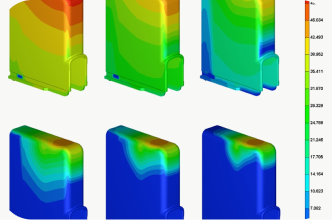
The examination of the packing phase covers the technological interval during which the holding pressure created by the injection molding machine is applied through the injection point. This lasts from the set switch-over point (filling or pressure-controlled) until the gate freezes or the nozzle closes. The entire phase aims to reduce shrinkage and warpage, thereby improving product quality. A critical parameter during the process is determining the appropriate holding pressure time, as both too short and too long holding pressure phases can lead to uneven shrinkage, resulting in warpage.

Cooling

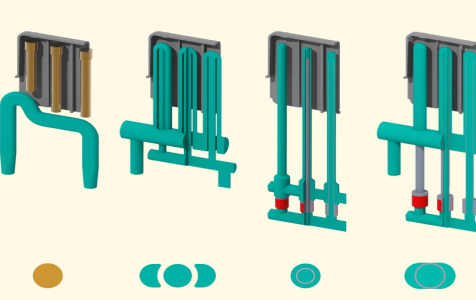
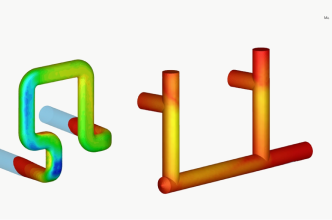
During the cooling analysis, we have the opportunity to examine the entire thermal balance of the injection molding process and its fluctuations, even simulating steady-state operation using transient analysis. This is a very important part of the process, as it usually constitutes the largest portion of the total cycle time, and its uniformity directly affects the quality of the product (warpage). With the help of simulation, we can easily test numerous cooling concepts to find the one that provides the desired results in terms of both efficiency and uniformity. In the case of a final cooling concept, it can assist us in determining the appropriate parameters (temperature, flow rate), thus ensuring that the Reynolds number and the efficiency of the cooling circuit are truly optimal.

Wrap

Warpage is the greatest enemy of the dimensional accuracy and shape fidelity of a product. Since warpage can be caused by multiple factors, which may also depend on each other, it is not easy to determine its exact cause. With warpage simulation, we are able to examine these effects simultaneously or separately, thus gaining an overall picture of the warpage. During the search for a solution, we can also examine individual components one by one. Depending on the nature of the project, we can then work on solving the problem or use the deformed and compensated product files generated by the software to make corrections.